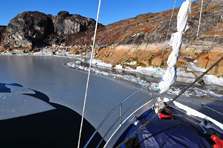
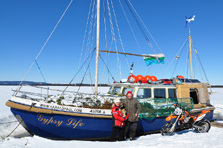
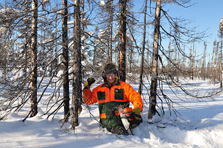
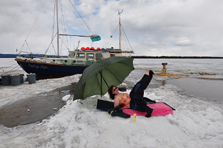
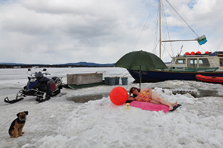
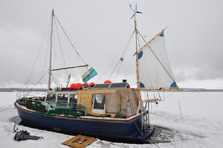
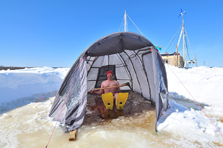
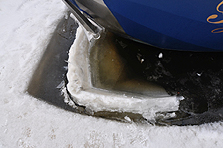
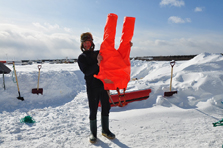
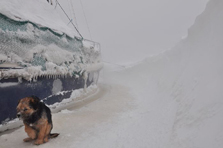
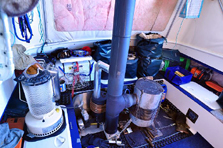
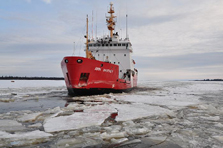
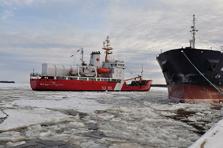
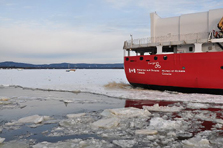
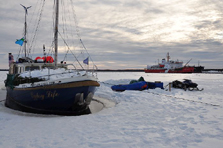
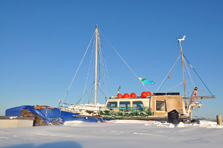
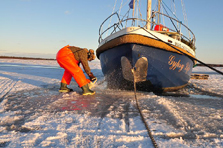
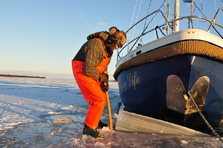
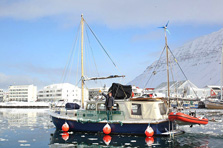
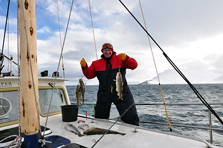
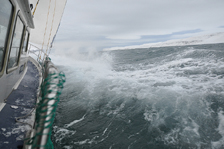
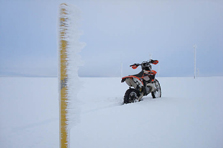
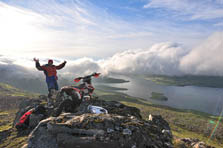
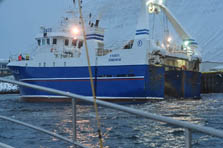
It is my aim always to come away from an expedition with a result, even if, as with this one, it turns out somewhat longer in its wording. That this can come about as independently and neutrally as possible, without being funded by institutes or specialist investors, and that it is freely accessible to the public. I could not quite fulfil the tasks I had set myself, to research a great deal about the natural conditions on the spot and, where possible, to back it up with photos, because it was considerably more difficult than I had hoped. But some of it can again be added to the findings that have accumulated in the high latitudes from 2002 to the present day. Many new findings about snow and ice conditions were gathered during the four winterings on the spot. That the outside temperatures do not have as great an effect on changes in the ice as is always reported, but that the surface temperatures, through differences in colour, are far more decisive. That changes in the ice depend on many other factors altogether, such as wind, tide and so on. That structural damage to the ice, brought about by ever-increasing shipping, still does the greatest harm of all. That this increase relates not only to the number of ships but also to the way they are built. Ice a good metre thick is nowadays no problem even for a fishing vessel, which was not the case years ago. The growing number of ships that keep pushing through the ice thereby keep a channel open, into which the wind with its destructive waves can work unhindered. Once a start has been made there is no stopping it, and the ice begins to move, is broken up and thus becomes the plaything of every force acting on the water. So the structural damage to the ice remains long-term damage that cannot be made good, damage to which no attention whatsoever is paid and which keeps eating its way like a fire through the untouched ice surfaces that still remain. As a result the protective armour of ice along many coastlines has been broken. The Inuit are pleased about this, because it means they can fish, hunt and carry goods largely unhindered. Furthermore, people have become more flexible over a longer part of the year, because the boat is and remains one of the main means of transport in the north. It looks quite different with the glaciers, which over the years had formed far down to the coastline. From these the wedge has been broken away, the sheet ice in front of the end of the glacier. Because of its shape, which slopes down into the water, the glacier can now slide unstoppably into the sea. The hard freshwater ice could not withstand the tide with its constant rise and fall, and above all the waves gnawing at the edge of the glacier over the years. It is broken and slides into the sea.
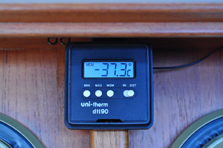
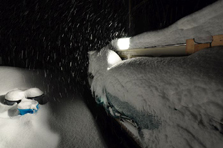
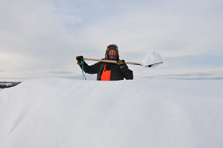
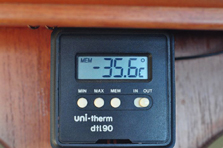
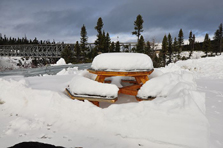
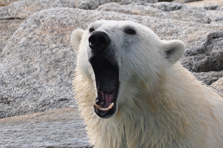
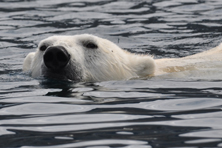
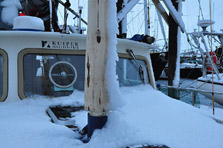
Where these forces can barely act on the edge of the glacier because of geographical shelter, as for example in southern Greenland in Prince Christian Sound, the glacier stays as it is for years and changes only insignificantly. No matter whether it is ten degrees warmer or colder. In any case the temperatures at such a mighty glacier are quite different from what is measured at the few measuring stations scattered about the land. Something I also had to note at sea, that the outside temperatures are considerably lower than in the coastal area. That masses of ice in the water affect the water temperature, and in their immediate surroundings the outside temperature and even the weather conditions as well. That masses of ice altogether, whether in the water or on land, have considerable effects on the weather. In this way we were able to protect ourselves from storms, which mostly screwed their way anticlockwise from America towards Greenland, by fleeing into a fjord that lay close to the inland ice, or behind a belt of pack ice lying offshore in the water. Many of these storms bounced off the heavy, cold masses of air that always form like a wall around the ice. That was so not only in Greenland, but also in 2009/2010 during the first wintering in Labrador, Canada. But if you lie, as we did over the winter of 2015/2016 in Greenland, in an area out in front of a shield of cold air, you get to feel considerably higher wind speeds. The incoming masses of air are compressed in front of the cold shield and their speed is considerably increased. They then have to escape to the left because of their original spin, and destroy everything that stands in their way. I cannot confirm the weather men’s claim that such a wind forms off the inland ice, because then it would necessarily have to be cool or cold. Yet whenever we had such hurricane-force winds through the winter months, which sometimes came several times a week, we also got pleasantly mild temperatures of up to 12° for a few hours, even in the depths of winter. The inhabitants spoke of the “hot wind”. These developments could also be followed exactly on the weather charts. That the weather conditions on the east coast of a country behave differently from those on its west coast was recorded in the logbook over the years, in the winter as well as the summer months. So it turned out that the winters on the eastern side of Canada, down below the 50th parallel, are so cold that even the polar bear still felt at home there. This parallel runs roughly through Frankfurt am Main. An unthinkable catastrophe if a few polar bears were to stroll through Frankfurt. People already get the jitters and are standing on their heads over the few wolves that roam about there. Furthermore it turned out that inhabitants judge weather situations completely differently, even though the people I asked were staying in the same place. The statements were so contradictory that not a trace of agreement emerged. That comes not only from everyone seeing it with different eyes, but also because the weather conditions in such a place behave differently on account of the shape of the land. During the wintering of 2014/2015 near the town of Goose Bay in eastern Canada I was able to observe enormous differences in the temperatures, wind directions and their strengths between the measuring station at the airport and the place where I lay, only about 3 km away. That the wind directions and their strengths behaved differently I could still follow, given my somewhat more open position, but that the temperatures sometimes differed by as much as -10° was surprising. As a result it is and remains inexplicable how science means to establish a temperature rise of 1° or 1.5° over the years across the Arctic archipelago of millions of square kilometres, which of course includes the areas of water, with the handful of measuring stations scattered about. This figure could already be called into question by the production tolerances of the individual instruments. What makes such precise measurements more difficult is not only the too small number of measuring stations, but the constant stormy winds, often at hurricane force and in part in summer too, which whip across these surfaces and thus thoroughly mix the layers of air. In any case it is very hard to follow how, in the short Arctic summer of about three months, temperatures that barely reach double figures are supposed to rise so far that everything melts away. There are limits to the much-praised satellites as well. Even when fine colourful pictures of stretches of water with little ice appeared on the screen, there were serious differences on the spot which could not be shown because of weather conditions such as fog and heavy snowfall. Even up-to-date local information passed on by radio, which is mostly based on satellite pictures as well, could not always be confirmed on the spot. So it often happened that the ice concentration given differed considerably from the figures and that there was much more ice on the surface of the water, so that I got into hopeless situations with my ship. Whether science, in its reports published through the media, offers any actual proof of such a warming and of the catastrophic effects that follow from it, with the choice of words it uses, “we assume, or we believe, according to estimates, by one projection it could be, the statistics say”, and so on, remains unresolved to this day in any case. By rights Florida and Holland ought already to be standing under metres of water, as was claimed in the media years ago, since sea levels have supposedly been rising for years because of the enormous melting. The Northwest Passage ought to be free of ice and as navigable for shipping as a four-lane motorway. The polar bears ought to be dying off like flies because their habitat is melting away under their paws. In that respect it only surprises me that during our winterings we had to cope for months with ice up to 1.80 m thick around our boat, snow more than two metres deep, outside temperatures of nearly -40° and surface temperatures far below -58°, and that even in the few summer weeks the long johns could not be packed away. That the shooting quota for polar bears along Labrador was raised, because their population rose so rapidly not only because of the good living conditions but also because of the seal embargo. In Greenland too, after the latest estimates of animal numbers, there is discussion about increasing the number shot. But of course you find nothing about that in the media; it would be another piece of evidence against the alleged global warming. It is also odd that reports are mostly only about Greenland, and the west coast in particular. What about the whole east coast of Greenland and the east coast of Canada, is it perhaps too cold and too icy there for any reporting? Is it not getting hotter in Africa or elsewhere in the south as well? That I do not stand alone with these findings was often confirmed to me in personal conversation with the scientists on the spot, whom I met at the stations or on land and at sea. The discussion was often sharp. So the subject of glacier retreat as representative proof of the warming came up again and again. The glacier is melting, it is retreating, and you see the meltwater running beside and beneath the glacier, on which the ice can slide down as if on a chute. When I then asked how they mean to prove that this water really is meltwater, and whether it could not be that it perhaps comes from nearby springs, which as we know also rise close to a mountain summit? Whether it could not be rainwater collected from higher ground? Furthermore, reports are always only about the retreat of a glacier; what about the new ice that forms from snowfalls metres deep. This snow, which is sometimes so deep that the inhabitants can no longer get out of their houses by the door but use the roof hatches instead, is after all pressed into ice in the course of the years. Such discussions quickly lost their edge. Over the years that my wife Silvia and I spent there, we could make out no clear trend in the one direction or the other. Just as the inhabitants also confirmed, there is a constant up and down in every area of the weather and the ice; even so, the tendency is rather that in recent years there have been worse and more extreme weather conditions, in which it became colder. People always hoped and waited for the weather to improve, and sometimes it settled a little for days at a time; even so, it was much easier to count the warmer, sunny days over the summer than the days with rain, snow, the thickest fog, or those cooled down close to freezing point by the wind. So the words “global warming” have become a subject that can no longer be stopped and that above all spreads fear and panic, one that moves huge amounts of money and unfortunately wastes it as well. But in proportion hardly any benefit reaches nature. Yet with minimal effort some help could be given to nature in the north. Most settlements and towns as well have no sewage works that could clean the waste water contaminated with chemicals. Everything is let into the sea untreated. The organic matter is not the main problem here, but all the heavy metals and chemicals from the washing and cleaning products. Of course it would be an enormous undertaking to cut such works out of the rock. But by the polluter-pays principle (what you do not dirty, you do not have to clean) it would be an easy matter to put things right. Industry has had biodegradable products for years, which could be put to their most sensible use here, but which unfortunately are hardly used at all. The same applies to waste disposal. Greenland is streets ahead of Labrador, where rubbish tips are to be found at the end of almost every dirt track that peters out and whole stretches of country are contaminated. But in general the problem is nowhere near a standard that supports nature. So it would surely be timely to see to such matters for once, so that one might perhaps have a tangible result, such as how many tonnes of chemicals or waste have not been delivered to Greenland, instead of an intangible result that cannot be followed: we do not want to let the temperature rise by more than 1° this year. Should institutes, media or individuals have suggestions or indeed criticism of this summary, they should not be shy about sending me an email; I answer them all and reserve the right to publish some that are of interest to the public. Finally let it be mentioned that I am well aware that a result like this, from a non-academic such as I am, who carries no professor’s or doctor’s title in front of his name, is given little credibility, particularly in Germany. I cannot change that, but it would not alter or affect the facts either. Yet let it be said that I have almost 40 years of practised experience in dealing with nature, and that I can live in it even without industrial support. That my grounding as an agronomist and forester with a focus on land reclamation has been a help to me in many respects. That in recent years my sensitivity to nature has been refined many times over through living in the wilderness, compared with a person living normally with a connection to civilisation. That this is really a basic requirement for gaining knowledge in a constantly changing nature and would therefore be preferable to any schematic computer program. Nature remains nature, and one should meet it with feeling, sensitivity and respect, and not try to kick it into a mathematical dustbin. Anyone who wants to gain an impression of the conditions in the Arctic region and of what things are like there, so as to judge the situation better, and to have information shown in pictures independently of the media, mixed with adventure, can do so through my two film productions “Expedition Ice” and “Canada Adventure”; anyone who would rather read can get it through my two books. Furthermore, some reports on the subject of nature from the collection “Paul’s Reports” are also a useful complement to the individual logbook entries on this website. If you are interested, get in touch with the individual distributors listed on my site under the heading Sales, or directly with me in person. In short: as long as, over the course of the year in the far north, the long johns, hat and gloves can be packed away on only a few days, not just by me but by the inhabitants as well, no one need speak of a global warming; better to put that initiative to more sensible use. See some photos of this for yourself in Photo gallery 2.